What Muscles Do Pull-Ups Work?
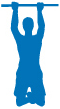
A strict pull-up is a full upper-body exercise. The muscles of your back and your biceps do most of the lifting, while your forearms keep you on the bar and your abs stop your body from swinging. The diagram shows the primary movers in red and the assisting muscles in orange.
Primary movers: back (latissimus dorsi, trapezius, spinal erectors), biceps.
Secondary and stabilising: forearms, abdominal muscles.
The back — the engine of the pull-up
The latissimus dorsi, the large muscle spanning from your armpits down to your lower back, pulls your upper arms down and toward your body — that movement is what lifts you to the bar. The trapezius and the muscles between the shoulder blades control the blades themselves: pulling them down and together starts every clean rep, which is exactly what scapular pull-ups teach. This is the muscle group that grows most over the weeks of the 50 pull-ups programme.
Biceps — the second primary mover
Your biceps and the deeper brachialis bend the elbows and work hard in every rep. How hard depends on grip: the underhand grip of chin-ups puts them in their strongest position, which is why most people manage more chin-ups than pull-ups. The full comparison is in pull-ups vs chin-ups.
Forearms — your connection to the bar
Every second on the bar trains your grip. For many beginners the forearms, not the back, are the first thing to give out during a set. If that sounds familiar, read strong forearms and try towel pull-ups once your strict reps are solid.
Abs — the quiet stabiliser
Your abdominal muscles keep your ribs down and your legs quiet so that all the pulling force moves you up instead of swinging you back and forth. In advanced variations such as L-sit pull-ups they stop assisting and become a primary target.
How grip changes the emphasis
- Wide grip — shifts more of the work to the lats by shortening the elbows' range.
- Underhand (chin-up) and close grip — let the biceps contribute more.
- Neutral grip — a middle ground that many shoulders find most comfortable.
No grip removes any muscle from the exercise — they change the balance, not the participants. The full list is in pull-up variations.
Train them all at once
You do not need to target these muscles separately — every strict rep trains the whole chain in proportion. Check your starting point with the pull-up test, review proper pull-up form, and let the 50 pull-ups programme handle the progression.