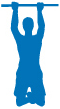
4-5 Pullups
Careful! This training is about lowering yourself, not pulling up!
If you did 0-5 pullups during the test the training of descending will be most effective for you. It will develop your muscles and raise your endurance and strength.
Durign the descending training you'll develop your strength and endurance better than while doing normal pullups (because you would be doing only few of them). You will do more descends and will work your muscles more.
How to perform the exercise of descending:
- Instead of pulling yourself up, stand on a stool and hang yourself on the horizontal pullup bar (with your chin just above it).
- Then get off the stool and descend slowly until your hands are straight.
- Repeat.
You have to descend as slowly as possible. You will achieve best results when descending from the stool until your arms are straight. It should take you about 3 seconds to do a full descend.
Good luck!
| If you did 4 or 5 pullups in the test | |||
| Day 1 120 seconds (or more) between sets |
Day 4 120 seconds (or more) between sets |
||
| set 1 | 4 | set 1 | 6 |
| set 2 | 9 | set 2 | 11 |
| set 3 | 6 | set 3 | 8 |
| set 4 | 6 | set 4 | 8 |
| set 5 | Exactly 9 | set 5 | Exactly 11 |
| Minimum 1 day break | Minimum 1 day break | ||
| Day 2 120 seconds (or more) between sets |
Day 5 120 seconds (or more) between sets |
||
| set 1 | 5 | set 1 | 7 |
| set 2 | 9 | set 2 | 12 |
| set 3 | 7 | set 3 | 10 |
| set 4 | 7 | set 4 | 10 |
| set 5 | Exactly 9 | set 5 | Exactly 12 |
| Minimum 1 day break | Minimum 1 day break | ||
| Day 3 120 seconds (or more) between sets |
Day 6 120 seconds (or more) between sets |
||
| set 1 | 6 | set 1 | 8 |
| set 2 | 10 | set 2 | 14 |
| set 3 | 8 | set 3 | 11 |
| set 4 | 8 | set 4 | 11 |
| set 5 | Exactly 10 | set 5 | Exactly 14 |
| Minimum 2 day break | Minimum 2 day break | ||
Pull-Ups on the Big Screen
Filmmakers love the pull-up, and it's easy to see why. It's a single, honest image of effort: a body hanging from a bar, hauling itself up on nothing but its own strength. You can't cheat it with a stunt double's timing or a clever cut, so directors reach for it whenever they want to show that a character is disciplined, dangerous, or dead serious about a fight ahead.
The most famous example is probably Rocky. In the 1976 film directed by John G. Avildsen, Sylvester Stallone's training montage includes one-arm pull-ups, and the image became shorthand for grinding, unglamorous preparation. The same beat shows up in The Dark Knight Rises (2012), where a caged Bruce Wayne rebuilds himself before returning as Batman, and in Rambo: First Blood Part II (1985), where Stallone's John Rambo works out in an improvised jungle setup that sells his self-reliance.
The exercise also does character work that dialogue can't. In American Psycho (2000), Christian Bale's Patrick Bateman grinds through pull-ups as part of an obsessive grooming routine, and the control on display reads as unsettling rather than admirable. Terminator 2: Judgment Day (1991) puts Arnold Schwarzenegger's T-800 on the bar to underline that this thing is tireless machinery wearing a human shape. In Captain America: The First Avenger (2011), the joke runs the other way: pre-serum Steve Rogers can barely manage one pull-up, and his struggle is exactly what makes him worth transforming.
Sometimes the point is just texture. Spider-Man: Homecoming (2017) gets a laugh out of Tom Holland's Peter Parker doing pull-ups in his suit, a reminder that even a superhero has to put in reps. Full Metal Jacket (1987) folds them into Kubrick's grim boot-camp sequences, one more rung in the machinery breaking recruits down. And in fitness-forward films like Pain & Gain (2013) and the MMA drama Warrior (2011), pull-ups sit inside longer training sequences that establish just how far the characters will push their bodies.
Across all these films the pull-up plays roughly the same role: a compact, wordless way to show us who someone is by showing us what they can do. Blockbuster or character study, it keeps earning its place on screen because the effort is impossible to fake.